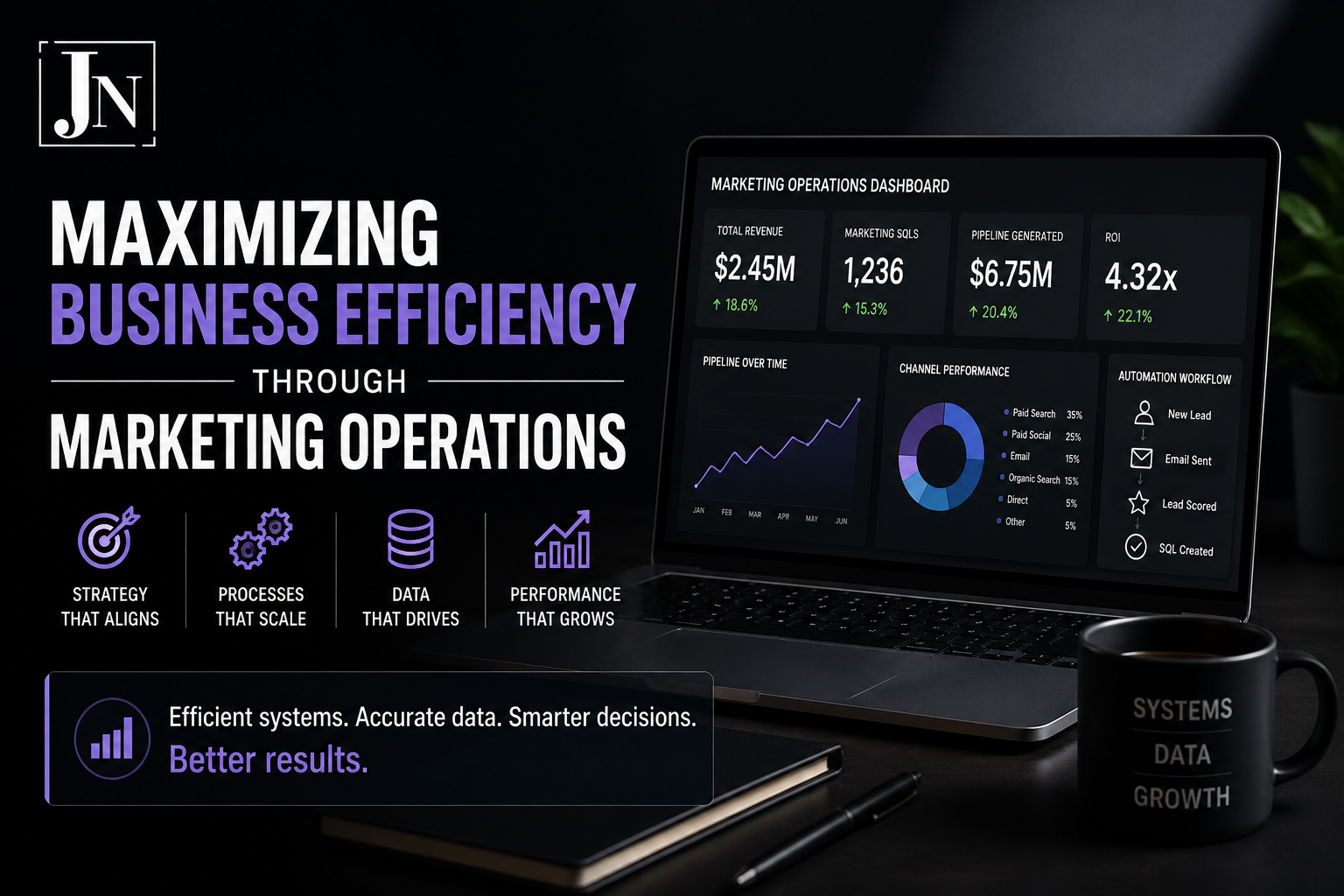

Understanding Marketing Operations
Marketing operations is the backbone of modern revenue-driven organizations. While marketing campaigns often receive the spotlight, the systems, processes, and technologies that power those campaigns are what ultimately determine scalability and long-term success.
At its core, marketing operations focuses on managing the infrastructure behind marketing efforts. This includes customer relationship management (CRM) systems, marketing automation platforms, attribution tracking, reporting frameworks, lead management processes, and operational workflows. By creating efficient systems, organizations can eliminate bottlenecks, improve team productivity, and make more informed business decisions.
As businesses grow, marketing becomes increasingly complex. Without proper operational oversight, teams often struggle with disconnected data, inconsistent processes, and inaccurate reporting. Marketing operations bridges these gaps by ensuring that technology, strategy, and execution work together seamlessly.
The Importance of Effective CRM Systems
A well-implemented CRM system serves as the foundation of successful marketing operations. Whether a company uses HubSpot, Salesforce, GoHighLevel, or another platform, the CRM acts as a centralized hub for customer and prospect data.
An effective CRM system enables organizations to:
- Track customer interactions across multiple channels
- Improve lead qualification and management
- Automate repetitive administrative tasks
- Enhance communication between sales and marketing teams
- Generate accurate reporting and performance insights
When properly configured, CRM systems provide a clear view of the customer journey. Marketing teams can understand where leads originate, how prospects engage with content, and which activities contribute to revenue generation.
Beyond lead tracking, CRM systems also help businesses maintain data integrity. Clean and organized customer data allows teams to make strategic decisions based on reliable information rather than assumptions. This ultimately improves forecasting accuracy, campaign performance, and overall business efficiency.
Marketing Automation as a Growth Driver
Marketing automation has become an essential component of modern business operations. As companies scale, manually managing every customer interaction becomes unsustainable. Automation allows organizations to streamline workflows while maintaining a consistent customer experience.
Common marketing automation initiatives include:
- Lead nurturing email campaigns
- Automated follow-up sequences
- Contact segmentation
- Lead scoring systems
- Appointment booking workflows
- Customer onboarding processes
By automating routine tasks, marketing teams can focus on higher-value activities such as strategy development, campaign optimization, and customer engagement.
Automation also improves response times. Prospects receive timely communication based on their behavior and interests, increasing the likelihood of conversion. Whether a visitor downloads a resource, submits a contact form, or books a consultation, automation ensures that no opportunity falls through the cracks.
Organizations that invest in marketing automation often experience improvements in operational efficiency, customer engagement, and revenue generation due to the consistency and scalability automation provides.
Attribution Tracking and Data-Driven Decision Making
One of the most challenging aspects of marketing is understanding which activities actually generate results. This is where attribution tracking plays a critical role.
Attribution tracking helps businesses identify the touchpoints that influence customer decisions. Instead of relying on guesswork, organizations can analyze data to determine which campaigns, channels, and content contribute to conversions.
Effective attribution tracking provides insights into:
- Marketing campaign performance
- Lead source effectiveness
- Customer acquisition costs
- Return on investment (ROI)
- Revenue contribution by channel
With accurate attribution data, businesses can allocate budgets more effectively and focus resources on initiatives that drive measurable outcomes. This creates a more efficient marketing operation and reduces wasted spending on underperforming channels.
For marketing operations professionals, attribution is not simply about reporting. It is about creating visibility across the entire customer journey and enabling leadership teams to make strategic decisions with confidence.
The Role of SOPs in Marketing Operations
Standard Operating Procedures (SOPs) are often overlooked but are critical to operational success. As teams expand, consistency becomes increasingly difficult to maintain without documented processes.
SOPs help organizations:
- Standardize workflows
- Improve team accountability
- Reduce onboarding time
- Minimize operational errors
- Increase efficiency across departments
Whether managing lead routing, campaign launches, reporting processes, or CRM maintenance, SOPs ensure that tasks are completed consistently regardless of who performs them.
Strong marketing operations teams rely on documented procedures to scale effectively while maintaining quality and performance standards.
Building a Scalable Marketing Operations Framework
Successful businesses understand that marketing is more than creative campaigns and lead generation efforts. Sustainable growth requires a strong operational foundation that supports every stage of the customer lifecycle.
By combining CRM systems, marketing automation, attribution tracking, and standardized processes, organizations can build scalable marketing infrastructures that drive long-term success.
Investing in marketing operations allows businesses to improve efficiency, enhance reporting accuracy, optimize resource allocation, and create predictable growth systems. In an increasingly competitive marketplace, companies that prioritize operational excellence gain a significant advantage over those relying solely on tactical execution.
Marketing operations is no longer a supporting function. It is a strategic discipline that enables businesses to scale, adapt, and thrive in a data-driven world.
Author Bio
Jerymiah Novales is a Marketing Operations Lead specializing in CRM architecture, marketing automation, attribution tracking, and process optimization. He helps businesses build scalable systems that improve reporting accuracy, operational efficiency, and revenue visibility. Follow the link to book a call